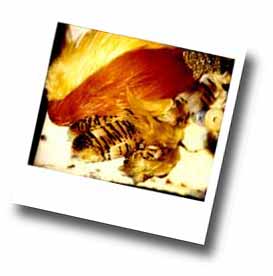
Some more of Sidney's fly tying materials, including African Junglecock and Golden Pheasant.

 et,
acceptance of the feather-wing patterns was hindered by the fact that
they were more expensive to buy.
et,
acceptance of the feather-wing patterns was hindered by the fact that
they were more expensive to buy.
"The traditional flies cost more because the materials were becoming increasingly difficult to get," he explained.
No wonder: in some cases, the birds used in certain feather-wing patterns were on the endangered species list. So like other tiers, Sidney learned how to improvise and substitute, making do with whatever was handy, even if it meant dying hackle feathers from ordinary chickens a bright pink or the fur of a squirrel tail a brilliant purple.
After 10 to 20 years of tying, Sidney said his knowledge and abilities grew.
"It took me about ten years to learn how to tie like a professional, but it wasn't easy. Tiers are funny lot, you know. They don't like competition, so it was hard to get someone to teach me."
Sidney recalls one time back in the 1940s when he saw a professional tier at work. As he leaned over to get a closer look at the man's techniques, the fellow stopped because he didn't want Sidney to learn too much.
"He automatically looked at me as a rival," he said.
Sidney also remembers
the two professionals in Atholville who ran a mass production line with
five or six women tiers. (In the past, women used to do most of the
tying because they were more adept with the fine work involved in the
art, and because of the patience it required. Even today, in some countries
such as Kenya, women still dominate fly tying). When he went to visit
the Atholville shop, the two male owners made it clear he wasn't welcome.
Top
of Page
Homepage | The Anatomy of a Salmon Fly Explained | Biography of Sidney Jarratt