
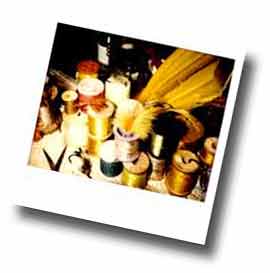
Some
of Sidney's fly tying materials,
including feathers, bobbins, thread and hand tools.

 he
brilliant hues of color, the strange exotic names of the individual flies,
and the usefulness of the finished product in catching fish immediately
attracted him to the art.
he
brilliant hues of color, the strange exotic names of the individual flies,
and the usefulness of the finished product in catching fish immediately
attracted him to the art.
With Herters Materials in hand and lots of ambition, Sidney set out teaching himself how to tie the flies that have become a major part of his life for the past sixty years.
"I was so unprepared I didn't even have a bobbin or bobbin holder," he recalled, chuckling at the memory.
At the beginning, Sidney used whatever materials he could get his hands on to make wet flies and streamers, such as the Edson Tiger and Grizzley King. He even sold a few to his friends, who like most New Brunswick fishermen in the 1940s and 1950s, were using hair wing extensively, especially on the Restigouche River. But then he caught the lure of traditional feather-wing fly patterns, an obsession that's stayed with him till this day.
In contrast to
its homely hair-wing cousin, the feather-wing patterns are a beauty
to behold and have a long history that goes back more than 500 years.
Based on ancient patterns developed in the British Isles centuries ago,
feather-wing flies incorporate elaborate and often expensive feathers
from the exotic jungles of Africa and South America into an irresistable
temptation for salmon and trout. Hair wing flies are based on essentially
the same traditional patterns but with deer, moose or bear hair for
example, substituted for the brightly colored feathers of the African
Junglecock or the Cockatoo, to name but two of the bird feathers Sidney
uses in his patterns.
Top
of Page
Homepage | The Anatomy of a Salmon Fly Explained | Biography of Sidney Jarratt