The Anatomy of a Salmon Fly < Home
The
Anatomy of a Salmon Fly
Homepage
| The Anatomy of a Salmon Fly Explained | Biography
of Sidney Jarratt


| A | B | C | D | E | F | G | H | K | L | M |
Source:
This Salmon Fly anatomy is found in How to Dress Salmon Flies A Handook
for Amateurs by T.E. Pryce-Tannatt, With an Appreciation by T. Donald
Overfield. Additional Material compiled by John Veniard and Freddie Riley.
Drawings by Donald Downs. Special Edition, by Van Dyke Press, Souderton,
P.A., USA, 1977, pp 10-21. (Note: This is an update of Pryce-Tannatt's
famous How to Dress Salmon Flies, which was printed in 1914).
B is the Butt. - Butts may be (i.) of herl (Ostrich or Peacock, the former dyed any colour you please, if not the natural black), or (ii.) wool - of all colours. (Back to Figure 1)
C is the Tail. - The basis of practically all tails is a Golden Pheasant topping. This is by reason of the fact that this particular feather has a fine translucent brilliance, and possesses a natural and convenient upward curve, which gives a neat and attractive finish. In addition to the topping, many tails have other feathers combined therewith, the most commonly employed being the orange breast feathers of the Indian Crow, strands of Golden Pheasant tippet and red breast feather, Summer Duck, Teal, dyed Swan. Gallina, Cock of the Rock, and Red Ibis feathers. Personally, I attach considerable importance to the tail, and consider that a brilliant transparency is a most important feature. (Back to Figure 1)
D
is the Body. - Bodies admit of considerable variety, but the most
prevalent are of (i.) Fur (either plain, or shaded, or contrasted). (*ii.)
Floss silk (either plain or shade, or contrasted). (iii.) Tinsel (either
gold or silver - flat, oval, or embossed; and they may be throughout of
the same kind of tinsel, or they may be divided up into or more kinds).
Any of these may be combined one with another (e.g, tinsel with fur, fur
with silk, silk with tinsel), and they may have two or more joints - i.e.
butted with herl, and veiled with certain feathers, such as Indian Crow
and Toucan breast feathers; or the joints may be just simply separated
from each other by a few turns of hackle, as in the majority of grubs.
Bodies of silk and tinsel are very commonly jointed. Less commonly bodies
are crewel, Berlin wool, natural fur, Peacock herl, Ostrich herl, or quill.
(Back to Figure 1)
E is the Ribbing. - The ribbing is practically always of tinsel in any of its varieties. In flies ribbed with flat tinsel and possessing a body hackle, twist is used as well, and is wound behind the tinsel as a protection to the hackle. (Back to Figure 1)
F
is the Hackle. - (f being the body or ribbing hackle, f'
the throat hackle, or just simply the throat). - Some flies have only
a throat hackle, others have a ribbing hackle as well, and in these the
throat may be of a totally different colour to the ribbing hackle. Sometimes
there are two throat hackles. Usually the hackles are domestic cock's
hackles, and more often than not these are dyed. Throat hackles, however,
are very commonly what are termed coarse-fibred feathers - e.g. Gallina,
Teal, Jay.
The Spey cock's hackle is a peculiarity which must be regarded as an exception,
both in character and in the manner in which it is put on.
Heron hackles (grey and black), and feathers from the thigh of the Golden
Eagle (dyed and natural), are very frequently used as ribbing hackles
in the Dee strip-wing patterns. (Back to Figure 1)
G
is the Wing. - (g being the under wing, g the upper
or covering wing). - From the fact that the wing is the most difficult
part of the salmon fly to dress, and that it admits of the greatest amount
of variation, both in colouring, quality, quantity, and method of putting
on, it is generally regarded as the most characteristic feature in salmon
flies, and through it and on it a classification of patterns can be and
has largely been based.
The different varieties are:
(i.) Ordinary or Simple Strip-Wings. - These may be set on (a) with an
upright inclination, or (b) more or less on a slant. The kind of feather
used as well as the manner in which it is put on will influence the set
of this variety of wing. For instance, the uprightness of a wing will
vary according to whether the feathers composing it are stiff fibred (e.g..
Turkey tail, Bustard) or soft fibred (e.g. Mallard, Teal), and it will
also depend upon whether "right" and "left" strips are employed for the
wings of the corresponding or the opposite sides. Similarly the slanting
character or droop of a wing is enhanced by using "right" and "left" strips
of a soft-fibred feathers, such as Mallard, to form the right and left
wings respectively, as, for example, in the Spey flies, in which drooping
wings are to be seen in their most pronounced form.
As regards the manner in which the wings are put on and the influence
this has upon the general effect the accompanying diagram (Figure
2 below) may perhaps help to make things clear.
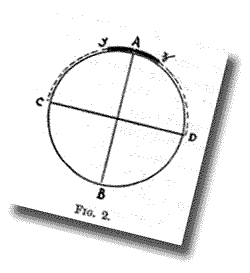
Now, speaking generally and ignoring for the moment the importance of the kind of feather used, uprightness in wings is secured by tying in both wings at the same time on the top of the hook-shank, and in such a way that each wings rests on its corresponding side of the middle line, and only occupies at the point where it is tied in a very small portion of the arc AC or AD, as the case may be (vis., the arcs Ay and Az). The fibres of the strips are pressed together by the dressing silk in much the same way as the folds of an accordian-pleated material can be pressed together, and the strips themselves lie in the same plane to the hook as a whole.
Slanting wings, however, are tied in each separately, and in such a way that they occupy the entire arcs AC and AD respectively. The fibres in this case are not pressed together by the dressing silk, but each individual one is pressed on to the hook-shank. This explains why in this style of winging it is not always easy to maintain the coherence of the strip as a whole as the natural relationship of the fibres to each other is apt to be disturbed, and the strip accordingly splits. Some feathers (e.g. Turkey tails) will not submit to this method of tying in without splitting, and they therefore require a special treatment.
In every case in all styles of winging it is most important that each wing should keep to its corresponding side of the middle line.
(ii.) Whole-Feather Wings. - These are composed of entire feathers (e.g. Golden Pheasant tippet and sword feather, Jungle Cock neck) set on upright in pairs, back to back.
(iii.) Mixed-Wings which are made up of a number of single strands of various feathers "married" to each other in one continuous "sheath".
(iv.) Built-Wings - These have as a foundation either a plain wing of paired upright strips or a whole-feather wing. Over this "married" fibres of several sorts of feathers are superimposed in batches of two or more.
(v.) Topping-Wings, in which Golden Pheasant crest feathers entirely form the wing.
(vi.) Herl-Wings, which are composed of strands or strips from either the tail or the sword feathers of the Peacock. (Back to Figure 1)
H is the Side. - Sides may be of Jungle Cock, Indian Crow, Summer Duck, or any other richly coloured or strongly marked feather. They occupy the central portions of the wings, leaving a strip showing both above and below, and sometimes they extend backwards as far as the butt, or where the butt ought to be. (Back to Figure 1)
K is the Cheek. - Cheeks are commonly of Jungle Cock, Blue Chatterer, or Indian Crow. They are superimposed upon the sides (where these occur), and are quite short. In some flies (e.g. the Akroyd) they are tied on so as to droop. (Back to Figure 1)
L is the Topping. - The topping is invariably from the Golden Pheasant's crest. The effect of a properly shaped and properly adjusted topping is to keep the wings together, and also to produce a glistening transparency to the upper edge of the wing, which is most effective in bright weather. (Back to Figure 1)
M represents the Horns. - Horns are usually obtained from the tail feather of the Macaw, and may be blue and yellow, blue and red, or scarlet - single strands of the feather used being as a rule. They constitute an element of mobility in a fly, and mechanically are useful in protecting brittle, delicate fathers, such as Jungle Cock, when these latter are used as cheeks or sides. They are usually put on last of all and over the topping. (Back to Figure 1)
Homepage
| The Anatomy of a Salmon Fly Explained | Biography
of Sidney Jarratt